

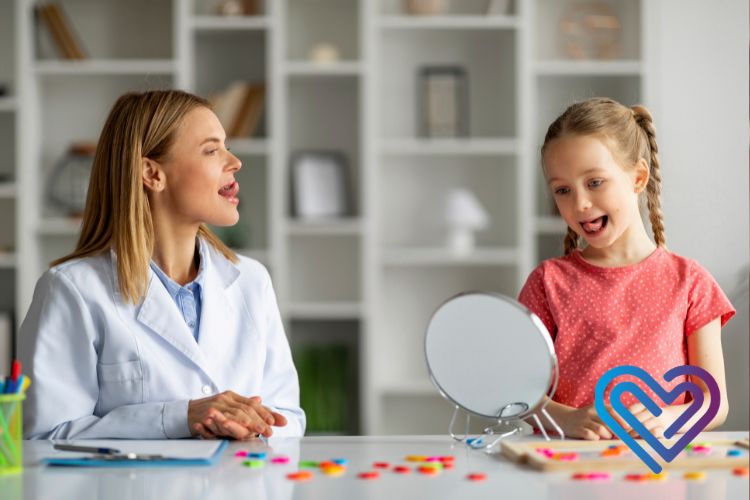
Communication is about much more than speaking. A child may use words, gestures, facial expressions, pictures, signs, or an augmentative and alternative communication (AAC) device. Some children with autism speak in sentences but need help with conversations, social cues, or explaining their needs. Others may communicate without spoken language.
Applied behavior analysis (ABA) therapy can help children strengthen communication in ways that are practical, meaningful, and individualized. The goal is not to make every child communicate in the same way. Instead, a well-designed ABA program focuses on helping each child express needs, make choices, connect with others, participate in daily routines, and gain greater independence.
Why Communication Can Be Challenging for Children With Autism
Autism affects each child differently. Communication differences may involve expressive language sharing thoughts and needs or receptive language understanding what others say. A child may also need support with the unwritten rules of social communication.
For example, a child may find it difficult to:
- Request a preferred item or activity
- Ask for help, a break, or more time
- Answer or ask questions
- Follow spoken directions
- Take turns during a conversation
- Understand gestures, tone of voice, or facial expressions
- Communicate discomfort, frustration, or emotions
- Use a skill with different people or in a new environment
These differences can sometimes lead to frustration. When a child does not yet have an effective way to say “help,” “no,” “I need a break,” or “that hurts,” crying, leaving the area, or other behavior may become the clearest available form of communication. ABA professionals look at what the child may be communicating and teach a safer, more efficient way to express the same need.
What Is ABA Therapy?
ABA is a science-based approach that studies how learning and behavior are influenced by the environment. According to the Centers for Disease Control and Prevention, behavioral approaches have substantial evidence for addressing autism-related skills, and ABA is one of the most widely used behavioral treatments.
In ABA therapy, a Board Certified Behavior Analyst (BCBA) evaluates a child’s abilities, needs, interests, and routines, then develops measurable goals and a personalized plan. Trained team members may provide direct therapy under the BCBA’s supervision.
Communication goals should be useful in the child’s real life. They may include requesting food, responding to a parent, using an AAC device, joining a game, telling someone to stop, or sharing something exciting. Progress is measured regularly so the team can adjust teaching strategies based on how the child responds.
How ABA Therapy Builds Communication Skills
1. Teaching Functional Communication
Functional communication means giving a child an effective way to express a real need or message. Rather than concentrating only on vocabulary, ABA therapy helps the child use communication for a purpose.
For example, if a child cries when a toy is out of reach, the therapist may teach the child to point, use a picture, press a button on an AAC device, sign “toy,” or say the toy’s name. The appropriate request is followed by access to the toy, helping the child learn that communication works.
This strategy is often called functional communication training. It can be used to teach requests for help, attention, preferred activities, breaks, and other important needs. As communication becomes easier and more reliable, frustration-related behavior may decrease because the child has a clearer way to be understood.
2. Breaking Complex Skills Into Manageable Steps
Communication can involve many skills at once. A conversation may require a child to listen, understand a message, decide how to respond, and deliver an understandable response.
ABA therapists can break complex skills into smaller steps and teach them at an appropriate pace. A child learning to greet a peer might first practice responding to a greeting, then initiating one, and later using greetings with several people in different settings. Mastering manageable steps can build confidence and create a foundation for more advanced communication.
3. Using Positive Reinforcement
Positive reinforcement makes a skill more likely to happen again by following it with something meaningful, such as praise, a favorite activity, or the natural result of communicating.
If a child appropriately asks for bubbles and receives them, the child experiences the direct benefit of communication. Over time, being heard, getting help, or connecting with someone may become reinforcing.
4. Using Prompts and Gradually Building Independence
When a communication skill is new, a therapist may use prompts to help the child respond successfully. A prompt might be a gesture, visual cue, model, spoken hint, or temporary physical guidance when appropriate. Prompts should then be reduced systematically so the child does not become dependent on them.
For instance, a therapist may initially model the phrase “help me.” As the child learns, the model may be shortened to “help,” changed to a visual cue, and eventually removed. The aim is independent, spontaneous communication—not a response that occurs only when an adult provides the answer.
5. Practicing Communication During Play and Daily Routines
Communication opportunities happen naturally during play, meals, schoolwork, and community activities. ABA therapy can use these moments to make skills relevant.
During play, a child might practice choosing an activity, requesting a turn, commenting on what happened, responding to a play partner, or handling a change in the game. During snack time, the child might request an item, indicate “all done,” or answer a choice question. The National Institute for Health and Care Excellence recommends considering play-based social-communication interventions that involve parents, caregivers, and teachers and that expand communication, interactive play, and social routines.
6. Supporting Social Communication
Some children have a large vocabulary but find the social side of communication difficult. ABA programs can address skills such as:
- Initiating and ending conversations
- Taking turns and allowing time for another person to respond
- Asking follow-up questions
- Making comments related to another person’s message
- Entering a group activity
- Advocating for personal space or sensory needs
- Repairing a misunderstanding
- Teaching should respect the child’s personality and boundaries. Eye contact, for example, should not be treated as the only sign of attention, particularly if it is uncomfortable or distracting for the child. Meaningful goals focus on access, understanding, connection, autonomy, and safety—not on hiding harmless autistic traits.
7. Helping Skills Carry Over to Everyday Life
A skill is most useful when a child can use it beyond therapy. This is called generalization. A child may practice asking for help with parents, teachers, siblings, or peers at home, school, or in the community.
ABA teams vary the people, materials, wording, and settings used during teaching. Majestic Care ABA’s family-centered approach includes caregiver collaboration to help families encourage communication during natural routines.
ABA Therapy, Speech Therapy, and AAC
ABA and speech-language therapy can complement each other, but they are not interchangeable. Speech-language pathologists evaluate and treat speech, language, social communication, and related needs. ABA professionals focus on learning and the conditions that help communication occur consistently.
With appropriate consent, the BCBA and speech-language pathologist may align goals, prompting strategies, and communication supports.
AAC includes picture boards, signs, and speech-generating devices. It is not necessarily a last resort or a replacement for speech. AAC can provide a reliable voice while other skills develop and should be tailored with qualified professionals.
What Progress May Look Like
Communication growth is different for every child. Early progress may be a gesture, a picture exchange, a purposeful device selection, or a single word. Later goals might include combining messages, answering a broader range of questions, describing an event, communicating emotions, or sustaining a back-and-forth conversation.
Families may notice that their child begins to:
- Request items or activities more independently
- Ask for help or a break before becoming overwhelmed
- Respond more consistently to everyday directions
- Make clearer choices
- Initiate interaction more often
- Participate more fully in home, school, and community routines
- Use communication with more people and in more places
ABA does not produce the same results for every child, and progress is rarely a perfectly straight line. Goals, teaching methods, intensity, and pace should be based on ongoing assessment, family priorities, and the child’s individual response.
How Families Can Encourage Communication at Home
Parents and caregivers play an essential role in helping communication become part of everyday life. Families can support growth by creating opportunities without pressuring the child to perform.
Offer meaningful choices, allow time to respond, and recognize appropriate communication in every form. Follow your child’s interests and respond when possible so the child learns that the message matters.
Consistency is helpful, but communication should remain natural and respectful. Ask the child’s treatment team which prompts to use, how long to wait for a response, and how to reinforce new skills. Strategies should be realistic enough to fit into family life.
Individualized Communication Support at Majestic Care ABA
Effective support begins with understanding the whole child. At Majestic Care ABA, goals can reflect a child’s strengths, preferences, daily needs, and family priorities. Individualized assessment, evidence-based teaching, data review, and caregiver collaboration can build communication that supports connection, choice, safety, and independence.
If you would like to learn whether ABA therapy may be appropriate for your child, explore the Majestic Care ABA enrollment process or contact our team. We can answer your questions, explain the assessment process, and help your family understand the next steps toward personalized support. You can also view our ABA therapy locations and service areas to find care near your family.
This article is for general educational purposes and is not a substitute for individualized medical, developmental, or therapeutic advice.