


Key Points:
- PECS (Picture Exchange Communication System) teaches children to communicate using images before or alongside speech.
- It can significantly reduce frustration and improve social interaction when used consistently and correctly.
- Pairing PECS with ABA therapy enhances results and supports long-term communication growth.
Helping a child with autism communicate can feel like unlocking a secret language. Many parents watch their children struggle to express needs, leading to frustration and emotional outbursts. The Picture Exchange Communication System, or PECS, was created to bridge that gap—offering a way for kids to communicate even when words are hard to come by.
But does PECS really work? And how can families make it part of everyday life? Let’s take a closer look at how PECS supports communication in children with autism, how it’s implemented, and how it can be combined with ABA therapy for the best outcomes.
Does PECS Really Help Kids with Autism Communicate?
Yes. The Picture Exchange Communication System (PECS) has been shown to effectively help many children with autism develop functional communication skills. By teaching children to exchange pictures for desired items or actions, PECS builds a foundation for meaningful interaction and reduces frustration caused by communication barriers.
Over time, many children progress from using pictures to verbal communication as their confidence and understanding grow. While results vary for each child, research and clinical practice consistently support PECS as a valuable tool for enhancing communication in children with autism.
What is PECS (Picture Exchange Communication System)?
PECS stands for Picture Exchange Communication System. It’s a structured way for individuals—especially children on the autism spectrum—to communicate by using pictures instead of spoken words.
Developed in the 1980s by Dr. Andy Bondy and Lori Frost, PECS is based on behavioral principles from Applied Behavior Analysis (ABA). The method focuses on teaching functional communication: not just labeling pictures, but using them to ask for something or share an idea.
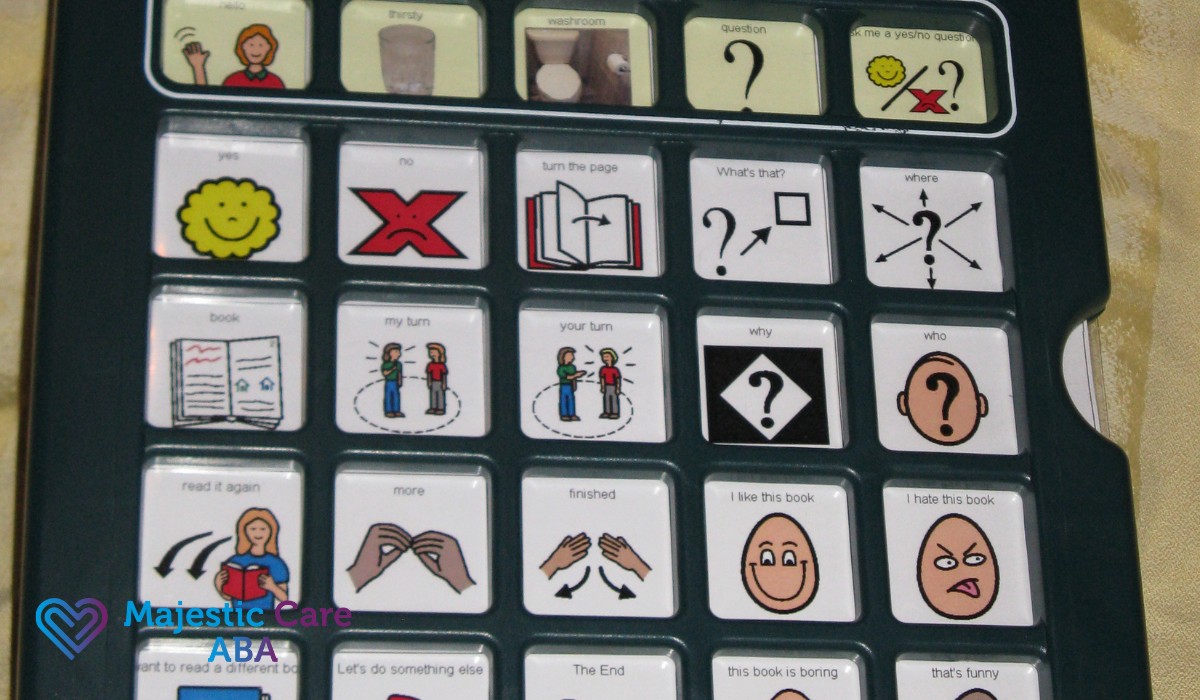
Children using PECS start by handing over a simple picture (for example, of a cookie) to request that item. Over time, they learn to combine symbols, use sentence strips like “I want [item],” and even respond to questions or express emotions.
What makes PECS unique is that it’s not reliant on technology or speech devices. All it needs is a set of laminated images or cards representing objects, actions, and concepts relevant to the child’s life.

How PECS Works for Children With Autism
PECS follows a six-phase teaching protocol that builds communication step by step. Each phase focuses on developing independence and motivation, ensuring that children don’t just learn symbols but understand their meaning.
Here’s a breakdown of how PECS is taught:
Phase 1: Learning to Communicate
The child learns to exchange a single picture for a desired item or activity. A communication partner helps prompt the exchange, while another person acts as a physical prompter if needed.
Phase 2: Increasing Spontaneity and Distance
The child learns to initiate exchanges independently, even when the communication partner is farther away. This helps generalize communication beyond structured sessions.
Phase 3: Picture Discrimination
Children begin to choose between multiple pictures to make specific requests (for instance, picking between “juice” and “toy”).
Phase 4: Building Sentences
Using a sentence strip, the child learns to form sentences like “I want swing” or “I want snack.”
Phase 5: Answering Questions
The learner starts to respond to simple questions such as “What do you want?”—a major leap toward conversational communication.
Phase 6: Commenting
Finally, children learn to express more than wants and needs. They begin to comment on the world around them: “I see birds” or “I hear music.”
Each stage helps build not just vocabulary but confidence—the understanding that communication gets results.
Key Benefits of PECS for Nonverbal or Minimally Verbal Kids
PECS has been widely studied and used in classrooms and therapy settings across the world. Parents often see positive changes within weeks of consistent use.
Here are the major benefits explained in depth:
1. Reduces Communication Frustration
One of the biggest sources of meltdowns in children with autism is being unable to express what they want. PECS provides a visual outlet. When a child realizes they can get what they need through pictures, stress levels drop and emotional regulation improves.
2. Builds a Foundation for Speech Development
Contrary to common fears, PECS does not stop children from speaking. Many actually start vocalizing after using pictures to communicate. Once children experience the success of being understood, motivation to use words often increases.
3. Encourages Social Interaction
PECS involves a natural exchange between two people—eye contact, reaching out, waiting for a response. Over time, these micro-interactions strengthen social skills that speech alone doesn’t always teach.
4. Promotes Generalization Across Environments
Children can use their picture cards at home, in therapy, or at school. With consistent training, communication becomes part of everyday routines—from snack time to playdates.
5. Builds Independence
Instead of relying on parents to guess what’s wrong, children using PECS can initiate their own communication. This autonomy empowers them and reduces caregiver stress.
When guided by a Board Certified Behavior Analyst (BCBA), PECS becomes more than a communication system—it becomes a bridge toward expressive language and self-advocacy.

Common Challenges and How to Overcome Them
While PECS can be life-changing, it’s not always smooth sailing. Parents often encounter obstacles in the learning process. The good news is that most of these can be resolved with consistency, coaching, and collaboration between families and therapists.
1. Lack of Motivation
If the chosen pictures don’t represent something the child actually wants, they won’t engage. Start with highly preferred items—favorite snacks, toys, or activities—and build from there.
2. Limited Picture Understanding
Some children may not initially grasp that a picture represents a real object. You can strengthen this connection by pairing the image with the actual item repeatedly during daily routines.
3. Inconsistency Across Environments
Progress can stall if PECS is used only in therapy. Parents, teachers, and caregivers should all use the same system, ensuring the child gets regular practice in different settings.
4. Overreliance on Pictures
The goal isn’t to stay on pictures forever. With time, therapists can fade prompts and encourage spoken words, gestures, or device use as the child’s communication skills evolve.
5. Misinterpretation by Others
If teachers or relatives aren’t trained in PECS, they might not respond correctly to exchanges. Providing them with quick training or visual guides ensures consistency for the child.

PECS vs. Other Communication Methods
Parents sometimes wonder if PECS is the only option—or the best one. In truth, it’s one of several evidence-based augmentative communication systems used in autism therapy.
PECS vs. AAC Devices
Augmentative and Alternative Communication (AAC) devices use speech-generating technology. These can be powerful tools, especially for older children. However, PECS is often a starting point because it’s simple, portable, and teaches the core idea of symbolic communication before moving to electronic aids.
PECS vs. Sign Language
Sign language is another effective option, but it requires fine motor coordination and the communication partner’s knowledge of signs. PECS, on the other hand, can be understood by anyone, regardless of their training.
PECS vs. Speech Therapy
PECS doesn’t replace speech therapy—it complements it. Speech therapists often collaborate with ABA professionals to combine PECS with articulation and language-building exercises.
Each child’s needs differ. That’s why programs like Majestic Care ABA use individualized assessments to determine whether PECS, speech therapy, or a blend of both will best support progress.
How Parents Can Make PECS More Effective at Home
PECS thrives when used consistently across daily routines. The home is one of the most powerful places to practice because communication opportunities are everywhere.
Here’s how you can make it work day-to-day:
1. Keep the Pictures Handy
Have PECS cards easily accessible in common areas—on the fridge, near toys, or on a communication board. The more reachable they are, the more likely your child will use them spontaneously.
2. Practice During Natural Moments
Instead of setting aside “PECS time,” use it during meals, play, or errands. Encourage your child to hand you a picture when asking for food, or point to a symbol during playtime.
3. Respond Immediately
When your child uses a picture, honor the request right away. That immediate success strengthens the understanding that communication works.
4. Update Pictures Regularly
As your child’s interests and routines change, so should their PECS set. Outdated pictures can cause confusion or reduce motivation.
5. Combine With ABA Strategies
ABA therapists help reinforce PECS through prompting, reinforcement, and generalization techniques. This makes communication skills more natural and long-lasting.
When parents and therapists collaborate closely—sharing data, discussing progress, and practicing the same strategies—children make faster, more meaningful gains.
The Role of ABA Therapy in Supporting PECS Progress
ABA therapy and PECS often go hand in hand. ABA focuses on understanding why behaviors occur and teaching replacement behaviors—like communication—instead of frustration or aggression.
Through individualized programs, ABA therapists can:
- Identify communication goals based on your child’s current abilities.
- Teach PECS phases systematically using reinforcement techniques.
- Reduce problem behaviors that stem from unmet communication needs.
- Gradually transition from picture exchanges to verbal or digital communication when ready.
The focus is always on independence, confidence, and meaningful communication—not rote repetition.
Empowering Communication Through ABA Therapy
PECS is more than laminated pictures—it’s a doorway to understanding, connection, and self-expression. For many families, it’s the first time their child can clearly communicate a need or desire, and that moment changes everything.
If you’re exploring how PECS or ABA therapy can help your child communicate more effectively, Majestic Care ABA offers personalized programs designed to meet each child’s unique communication goals.
With services available for ABA therapy in Indiana, Colorado, and North Carolina, we’re here to help families build stronger, more confident communicators—one picture at a time.
Contact us today to get started or learn more about how we can support your child’s communication journey.